
Speech Analytics Trend Analysis: Detecting Compliance Risk Before It Escalates
VoizTrail’s Speech Analytics Trend Analysis module gives compliance and QA teams the ability to detect emerging risk patterns long before they escalate into audits or complaints. It compares data across weekly, monthly, quarterly, and yearly timeframes — making behavioral and compliance shifts visible in ways traditional snapshot reports simply can’t.
These include:
- QA and compliance Trends
- Agent and Consumer behavior shifts
- Consumer interaction trends
- Acoustic indicator trends
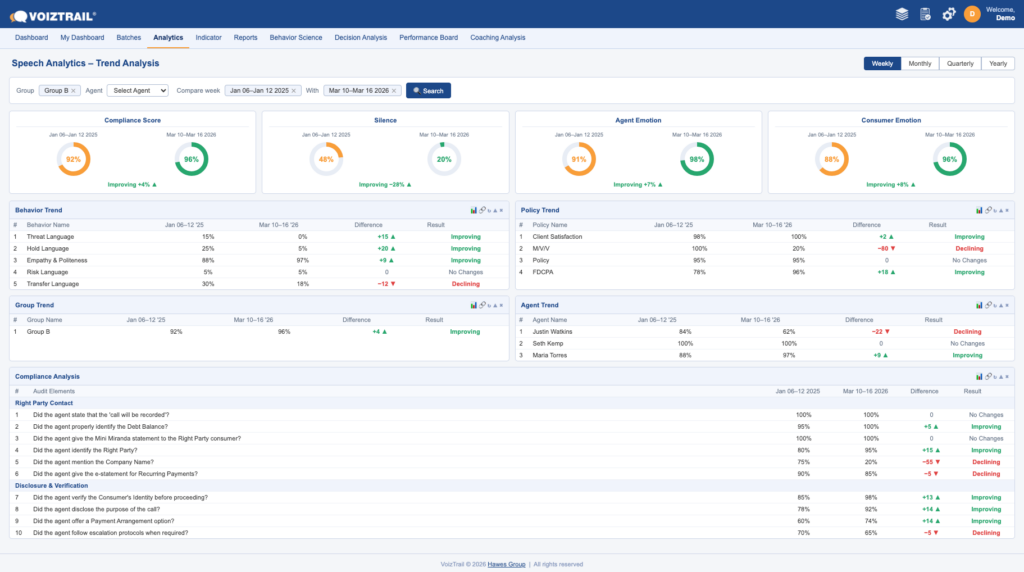
The Risk Isn’t the Call. It’s the Pattern.
One bad week is noise. A pattern is risk.
Most organizations review calls in snapshots (weekly reports, isolated QA scores, and one-off compliance reviews). That approach shows what already happened, but it rarely shows what’s forming.
VoizTrail’s Trend Analysis compares speech analytics data across weekly, monthly, quarterly, and yearly timeframes, side by side. This makes shifts in compliance behavior, agent performance, consumer responses, and acoustic patterns visible long before they escalate into audits, complaints, or operational breakdowns.
When trends are visible, problems can’t hide.
Speech Analytics Trend Analysis Reveals What Single Reports Miss
A single report shows what happened. Trend Analysis shows what’s developing.
Without Trend Analysis, teams miss slow-building issues that surface only after risk has already compounded:
• Compliance failures that grow quietly source source:
Small mistakes happen occasionally. But when the same mistake slowly appears more often, it becomes a pattern.
Example:
If one agent forgets a disclosure once, it’s not alarming.
If that same disclosure is missed 12 times over three weeks, that’s a compliance trend.
• Agent performance drift hidden by averages
Company averages can look normal even while one agent’s behavior is slowly getting worse.
Example:
If most agents maintain QA scores near 90%, one agent dropping from 88% to 70% may not impact the overall average — but it signals a developing performance issue.
Trend analysis helps leadership identify these shifts early and provide targeted coaching.
• Consumer behavior shifts across conversations
Changes in consumer responses can reveal emerging issues with messaging, policies, or economic pressures.
Example:
If consumer objections to payment plans increase steadily over several weeks, this may indicate a script issue, pricing concern, or changing financial environment.
Trend analysis helps teams identify these behavioral changes and adjust communication strategies accordingly.
• Localized issues masked by company-wide metrics
Problems affecting one team, campaign, or location can disappear inside company-wide reporting.
Example:
If one call center location struggles with disclosure language but the rest of the company performs well, the overall report may hide the issue.
Trend Analysis makes these localized risks visible.• Acoustic signals that reveal operational stress
• Acoustic signals that reveal operational stress
Speech analytics can also identify acoustic indicators such as interruptions, silence patterns, speaking speed, and vocal stress.
Example:
If interruption frequency increases across a team, it may indicate rising tension in conversations or ineffective call handling techniques.
These acoustic signals often reveal operational pressure before it appears in QA scores.
VoizTrail Trend Analysis allows teams to filter by time range, group, campaign, or individual agent, exposing emerging risk early, while it’s still easy to correct.
What Speech Analytics Trend Analysis Surfaces Immediately, and Why It Matters
Trend Analysis does more than highlight unusual results. It shows where the problem is coming from, so teams can respond quickly and accurately.
• 2:1 ratio of compliance failures from one agent vs. peers
This suggests the issue is likely isolated to training or behavior rather than a system-wide breakdown.
Example:
If most agents miss a disclosure twice a week but one agent misses it five times, leadership can coach that specific agent rather than retraining the entire team.
• 18% decrease in required disclosures month-over-month
This indicates compliance is slowly weakening, even if weekly reports still look acceptable.
Example:
Week-to-week reports may show small changes, but over several months disclosure, the accuracy drops significantly.
• 47 calls from one team driving 62% of QA flags
This reveals concentrated operational risk.
Example:
If one team handles only 20% of calls but generates most of the QA issues, leadership knows exactly where intervention will have the greatest impact.
Rising objection language from consumers
Trend analysis can reveal increases in specific phrases such as “I can’t afford that,” or “I already paid.”
This helps organizations identify changing consumer behavior and adjust scripts or policies accordingly.
Increasing acoustic stress patterns
An increase in raised voices, rapid speaking, or overlapping speech may indicate escalating tension within conversations.
These signals can help leadership identify training opportunities before customer complaints occur.
These are not random outliers. They are early warning signals.
Looking at “This Week” Means You’re Already Behind
Compliance risk rarely spikes overnight. It builds quietly: call by call and week by week.
But risk doesn’t only appear in compliance failures. It also emerges in agent behavior, consumer responses, and acoustic signalsthat indicate operational pressure.
VoizTrail’s Speech Analytics Trend Analysis reveals these patterns before regulators, complaints, or operational disruptions do.
And once you can see the pattern, you can stop it.
Try VoizTrail Free
Related VoizTrail Articles:
Empower Frontline Workers Page
Recommended Links
CFPB Compliance & Supervisory Guidance Page
FTC’s “Complying with the Telemarketing Sales Rule” Guide
McKinsey: “From Speech to Insights: The Value of the Human Voice”